

 HERRENKNECHT Milestone: First mechanized tunnelling under the Panama Canal successfully completed
The project marks a global milestone: For the first time, a tunnel was constructed under the Panama Canal using a tunnel boring machine (TBM). On October 26, 2026, miners and construction site managers, together with local political representatives, celebrated the breakthrough of the machine of the Mixshield type (13.5 meters in diameter) into the target shaft. For the machine manufacturer Herrenknecht, this new flagship project is part of a legacy of challenging crossings beneath waterways for the construction of high-performance transportation routes.
Tunnel construction under rivers, straits, and canals is one of the industry’s greatest challenges. As a rule, this involves overcoming demanding geological and hydrogeological conditions, such as unpredictable, complex ground conditions and high pressure from the surrounding groundwater. As a manufacturer of state-of-the-art tunnel boring machines, Herrenknecht AG has decades of experience and an unparalleled track record in this field. Those responsible for the first mechanized tunnel construction project under the Panama Canal therefore placed their trust in the specialists from Schwanau and ordered the XXL machine from Herrenknecht for the construction of Metro Line 3.
High-performance infrastructure
On the occasion of the celebrations marking the successful completion of the tunnel drive, Panama’s President, José Raúl Mulino, highlighted the importance of the new Metro Line 3: “This remarkable feat of engineering offers us a groundbreaking solution to the challenges we take on.” It will connect the western suburbs with downtown Panama City and provide an efficient transportation infrastructure for 250,000 commuters who, until now, have had to rely on a congested bridge to get to and from work. César Pinzón, director of Metro de Panamá, added: “Residents of the western suburbs, in particular, will benefit from safer and faster transportation, which will save them hours stuck in traffic.”
Safe Mixshield tunnelling
From the start of tunnelling in September 2024 until the final breakthrough on October 26, 2026, the tunnelling crews of the HPH consortium—comprising Hyundai Engineering & Construction, Posco Engineering & Construction, and Hyundai Engineering—excavated 4.5 kilometers of tunnel using the giant TBM. They achieved peak rates of up to 150 segment rings or 300 meters per month. The miners mastered both the tunnelling under the canal—one of the world’s busiest and thus most important waterways—at a depth of up to 65 meters below sea level, as well as the remaining 1.5 kilometers from the interim breakthrough to the future Balboa subway station in February 2026 with flying colors.
Jürgen Hoss, Head of Project Management at Herrenknecht, explains the success of the tunnelling from a technological perspective: “We have now advanced the development of the Mixshield machine type to such an extent that even a project like the one in Panama can be carried out safely and efficiently. The concept of the accessible cutting wheel, which allows the excavation tools at the front of the cutting wheel to be replaced from the rear under atmospheric pressure, has once again proven its worth. Likewise, the tunnelling through ground conditions that are rather atypical for a Mixshield over the last 1.5 kilometers did not present our client with any major challenges.”
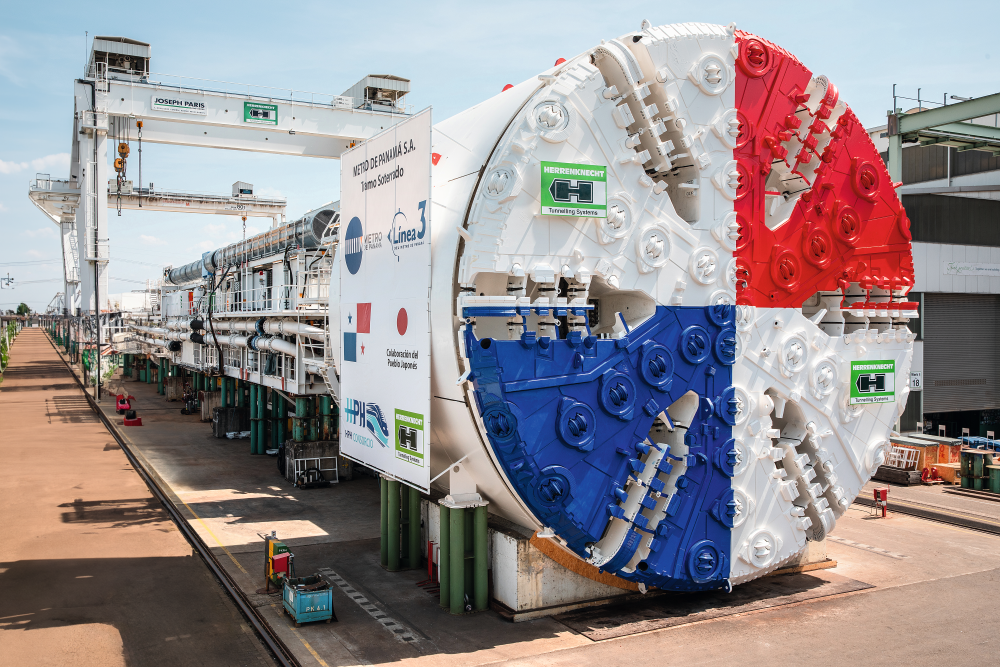
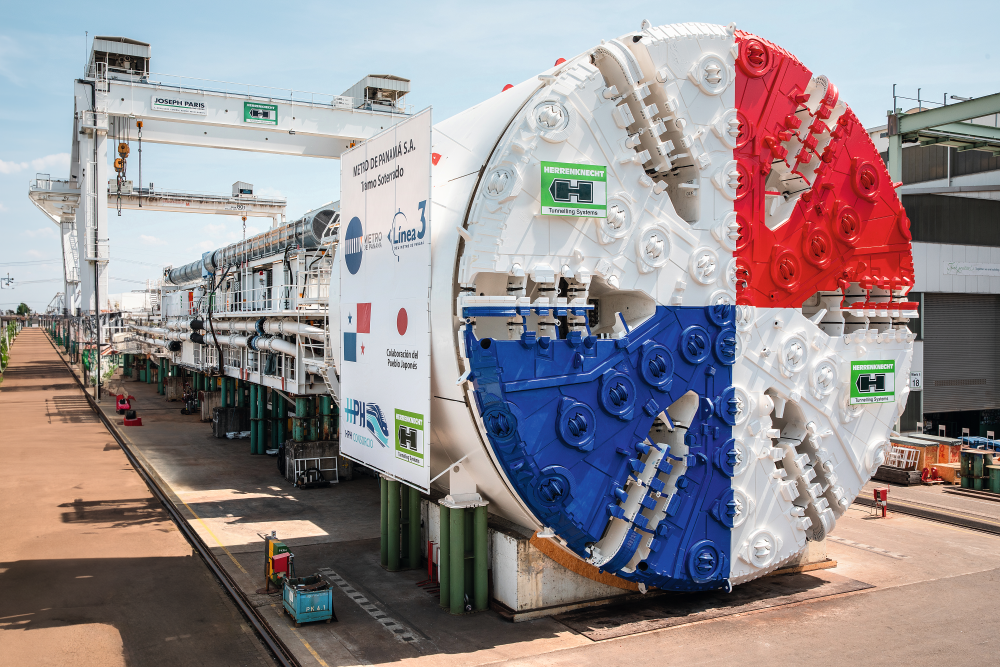
The performance of the machine supplied by Herrenknecht for Panama is based on nearly 30 years of experience with challenging underwater crossings in mechanized tunnelling. Many of these projects marked milestones in the industry because they pushed the boundaries of what was technically feasible, thereby paving the way for the next challenges.
“The tunnelling with TRUDE for the fourth Elbe Tunnel tube in Hamburg from 1997 to 2000 was a breakthrough for us in both senses of the word. Since then, our machines have crossed, among other places, the Yangtze River in China, the Port of Miami, the Bosporus, the Suez Canal, and an estuary in Hong Kong—where we even set a world record with a diameter of 17.63 meters,” says Dr.-Ing. E. h. Martin Herrenknecht, founder and CEO of Herrenknecht AG. “The successful tunnelling under the Panama Canal—for which I warmly congratulate everyone involved—continues this series.”
According to Martin Herrenknecht, Herrenknecht’s experience is currently also being incorporated into studies for a possible tunnel under the Strait of Gibraltar. “Whether a nearly 40-kilometer-long railway tunnel at a depth of up to 500 meters below sea level will one day become a reality remains to be seen. However, projects like Panama show how the boundaries of what is technically feasible can be pushed step by step.”
PROJECT DATA PANAMA METRO LINE 3
› Client: Metro de Panamá
› Contractors: Consorcio HPH Joint Venture (Hyundai Engineering & Construction Co., Ltd., Posco
Engineering & Construction Co., Hyundai Engineering Co. Ltd.)
› Application: Metro
› Tunnel length: 4.5km
› Geology: Sandstone, siltstone, tuff, clay and sand, breccias, mudstone, pyroclastic rocks, basalt and
andesite
MACHINE DATA
› Machine type: Mixshield
› Diameter: 13,460mm
› Cutterhead drive power: 5,600kW
› Torque: 26,616kNm